“101 Greats of European Basketball,” a limited-edition collection published in 2018 by Euroleague Basketball, honors more than six decades’ worth of stars who helped lift the sport on the Old Continent to its present-day heights. Author Vladimir Stankovic, who began covering many of those greats in 1969, uses their individual stories and profiles to show that European basketball’s roots run long and deep at the same time that the sport here is nurtured by players from around the world, creating a true team dynamic unlike anywhere else. His survey covers players who were retired before the book was published and who inspired the many others who came after them. Enjoy!
***
Zan Tabak – A triple Euro-champ with an NBA ring
I am not sure whether Split is the only town outside of the United States that has produced two NBA champs, but if there is any other, it will have a hard time putting together what Toni Kukoc and Zan Tabak accomplished. Between the two of them, they feature six EuroLeague titles in their club of origin, Jugoplastika Split, and subsequently four NBA titles (Kukoc with Chicago in 1996, 1997 and 1998 and Tabak with Houston in 1995). Both were in the Split team that won the EuroLeague three-peat in 1989, 1990 and 1991.
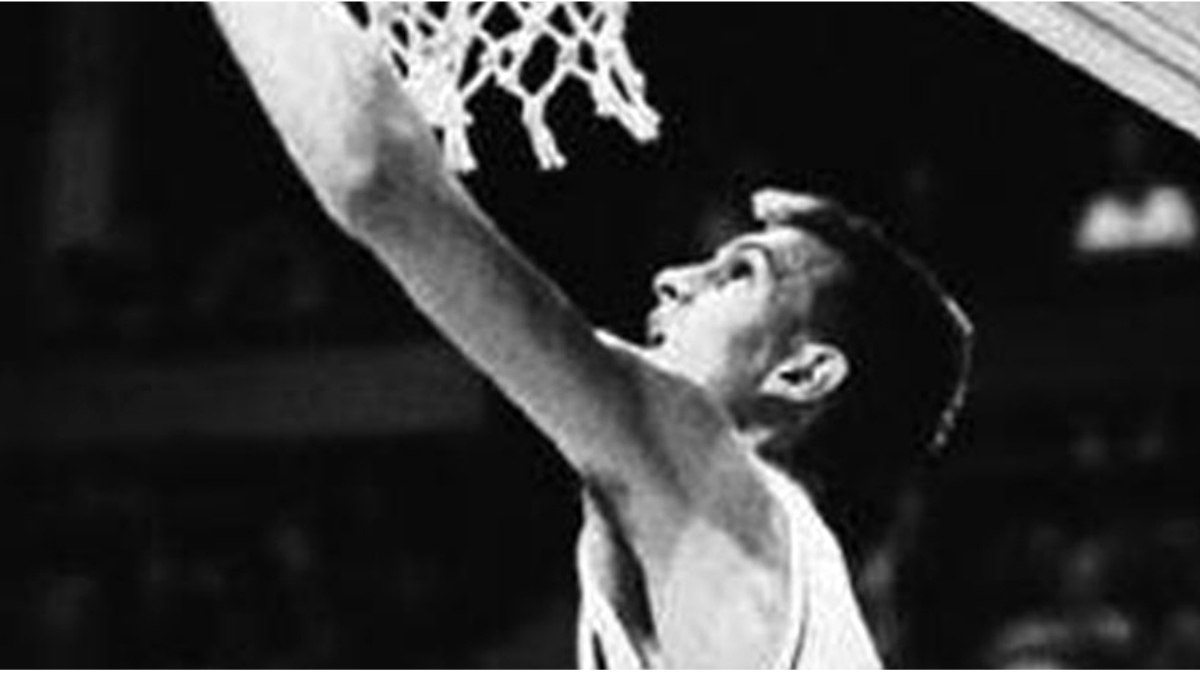
Zan Tabak, who was born on July 15, 1970, in Split, was never a superstar, a player around whom teams were built. But he was a player who always delivered when coaches gave him minutes on the court. As all big men, he got better with time and he played his best seasons when older than 25, even though his earlier seasons were already full of accolades. At 14 years old, Tabak stood at 1.97 meters and despite practicing all sports, his fate was basketball. He was lucky to enter the club at the start of the great project in Jugoplastika. His talent could not go unnoticed by the Yugoslav federation, and in the summer of 1987, Tabak was part of the FIBA European Championship for Cadets in Hungary. He came back with the gold medal as the third-best scorer on the team (8.9 points), after Arijan Komazec (28.4) and Zivko Badzim (11.4). The coach was Janez Drvaric from Slovenia.
The following year, at the 1988 European Championship for Junior Men in Yugoslavia, I would see Zan Tabak live for the first time. He was part of a great team coached by Dusko Vujosevic, who was not much older than his players. Komazec was the top scorer again (27.0) and the line of big men was very strong: Dzevad Alihodzic, Rastko Cvetkovic and Zan Tabak (6.5 points), while Predrag Danilovic (9.4) started to confirm his great talent after two years without playing due to bureaucratic problems with his club of origin, Bosna Sarajevo. That was another gold medal for Tabak and his teammates. The Great Jugoplastika
When he got back to Split, Tabak was soon recruited by coach Boza Maljkovic for the Jugoplastika senior team. Toni Kukoc and Dino Radja, that generation’s leaders, were two and three years older than Tabak, respectively, but Maljkovic had the vision, the patience and the courage to look for future talents. Nothing better could have happened to young Tabak than training with Radja and Goran Sobin and, starting in 1989, with Zoran Savic. At 19 years old, after winning the cadet and junior European championships, he was already a European champ with his club. Yes, his contribution might have been symbolic, but Zan Tabak’s name is on the Jugoplastika team roster that was European champ in 1989. His 2 points against Maccabi in the semifinal (87-77) and 2 against Barcelona in the final (75-65) may not have been a lot, but there he was, in the picture of the champs.
If the triumph of 1989 was a surprise, the repeat of the title one year later didn’t surprise anyone. The victims in Zaragoza were Limoges in the semis (101-83) and Barcelona in the final (72-67). Tabak was still a substitute center, but he was getting ready for a bigger role. The 1990-91 season arrived and with it, Radja had gone to Rome, Dusko Ivanovic went to Girona and Maljkovic started coaching Barcelona. Jugoplastika, under the new sponsor Pop 84, and with Zeljko Pavlicevic on the bench, repeated the title for a third successive year at the Paris Final Four. Kukoc, Savic, Velimir Perasovic, Zoran Sretenovic plus American Avie Lester (who played his career game in the final against Barcelona with 11 points and 3 blocks) were on the team. Savic was the hero of the final with his 27 points and Tabak contributed 2 points and 3 rebounds, but he had many good games during the season, including an earlier one against Barcelona in which he had scored 14 points.
At the end of the season, Tabak was chosen by the Houston Rockets in the second round of the NBA draft with the 51st pick. Not bad at all for a 21-year-old kid still with a lot of room for improvement. For the 1991-92 season, only Tabak and Perasovic remained from the great Jugoplastika three-peat. Apart from the normal departures, war was a factor. The Split team played its home EuroLeague games in La Coruña, Spain. Perasovic was the top scorer with 25.6 points and Tabak was already a crucial player in the team (13.9 points plus 7.9 rebounds). It was not a blank season for the team as, under the new name Slobodna Dalmacija, they won the first Croatian Cup in Rijeka. In the quarterfinals they destroyed Jug Drubovnik 94-67, in the semis they did the same to Sibenka (101-57) and in the final, the victim was Cibona, 88-65. The MVP? Of course, Zan Tabak. It was time for some individual accolades.
To the NBA, via Livorno
In the summer of 1992, Zan Tabak lived a dream together with his teammates by playing the Barcelona Olympic Games with Croatia and winning a silver medal. Drazen Petrovic, Radja, Kukoc, Perasovic, Stojan Vrankovic, Danko Cvjeticanin, Vladan Alanovic, Aramis Naglic, Komazec, Alan Gregov and Tabak made up a super team. Even though he was only 22, Tabak’s next step would be playing abroad. His first stop was Basket Livorno of Italy. After a very good season (14.9 points, 10.1 rebounds) his number of medals increased in the summer with a bronze for Croatia at the 1993 EuroBasket in Germany. His next step would be an Italian great, Olimpia Milano. He had another good season with similar numbers, 14.6 points and 10.7 boards.
At 24, he decided to try his luck in the NBA. Tabak signed for the Rockets, where he played alongside legend Hakeem Olajuwon, another great big man and great for Tabak’s improvement. Lo and behold, after his rookie season, Tabak had an NBA championship ring in his hands, too! The team, coached by Rudy Tomjanovich, of Croatian descent, swept the final series against Orlando, 4-0. For Tabak, it was a fourth continental club title. After three EuroLeague crowns, he had the NBA title, becoming the first European to win both leagues. It’s true that, again, his contribution was symbolic, as expected from a rookie, but he was there in the right place at the right time. He played the next three years for the Toronto Raptors and then another one in Boston. After four-and-a-half seasons in the NBA, Tabak decided to come back to Europe. He chose Fenerbahce of Turkey and he had a great season (13.1 points and 10 rebounds). That was enough for the Indiana Pacers to lure him back to the NBA.
Real Madrid, Joventut, Unicaja
At 30 years old, and after six and a half seasons in the NBA and 247 games, Tabak came back to Europe for good. He was signed by Real Madrid and had a solid season with 9.8 points and 7 rebounds. After that, he moved to Badalona to play with Joventut. It was the fourth club on which Tabak played – after Jugoplastika, Milano and Madrid – that had been a EuroLeague champion at least once. His numbers were even better: 12.6 points and 7.3 rebounds.
At 35 years old, Tabak got the call from Unicaja Malaga. Sergio Scariolo, who had coached him in Madrid, was looking for an experienced player, but things didn’t turn out as expected due to a back injury that Tabak suffered. He missed half a season and started playing a little before the King’s Cup in Zaragoza. But, again, it was the right moment for him as Unicaja managed to lift the prestigious cup title with a great team, including Carlos Cabezas, Jorge Garbajosa, Fran Vazquez, Berni Rodriguez, Walter Herrmann, Pepe Sanchez, Stephane Risacher … and Tabak, of course. He scored 10 points against Etosa Alicante in the quarterfinals and then 4 against Valencia in the semis. Tabak could not score in the title game against Real Madrid, coached by his former mentor, Boza Maljkovic, but he helped nonetheless.
Due to the bad back injury, Tabak could not deliver what was expected of him, but with his experience, he could help a young Fran Vazquez, who had a great breakout season. Zan was a great pro and set an example in every practice. Almost everything he did, he did well. He was almost perfect in the low post and could score with both hands. He played well with his back to the basket and was also a tough defender with rebounding abilities. He was not slow for his height and he ran well.
With a King’s Cup title under his belt, Tabak decided to retire. However, he knew he wanted to stay in basketball as a coach. He has since won both a EuroLeague and a EuroCup title as an assistant coach with Real Madrid, in 2007 and 2015, respectively. Before and after, he has been a head coach in Poland, Spain and Israel. Among his other head coaching positions in Spain, he took Baskonia Vitoria Gasteiz to the EuroLeague Playoffs in 2013. And in a replacement stint with Maccabi FOX Tel Aviv in 2016 he won the Israeli Cup.
Basketball was Tabak’s destiny even though he didn’t have it in his blood. Rather, he married into it. His father didn’t play the sport, but his wife Gorana had played in the Split women’s team and her father, Rato Tvrdic, was the captain of the great Jugoplastika in the 1970s and of the Yugoslav national team, European champions in 1973 and 1975. And since every big man needs a good point guard, Tabak was lucky to have one in the family.
Photo: Euroleague
