
It was August 28, 1982, the day of the final of the junior EuroBasket played in Bulgaria. In the big game, the finalists were the USSR and Yugoslavia. On one side, Jose Biriukov, Igor Miglinieks, Valeri Tokhonenko and Sarunas Marciulionis; on the other, Drazen Petrovic, Velimir Perasovic, Danko Cvjeticananin, Stojko Vrankovic. The Soviets won by 97-87 after a great first half (55-35). One year later, in Palma de Mallorca in the final of the second junior World Championship, the USSR lost to the United States by 78-82 even though it had a stronger team with Arvydas Sabonis (29 points), Aleksandar Volkov, Tiit Sokk, plus Tikhonenko, Marciulionis and Miglinieks. The Americans also had a solid team with Kenny Walker (22 points) and Scott Skiles (15).
Those were the first two finals, the first two medals, in the successful career of Sarunas Marciulionis, who was born in Kaunas, Lithuania on June 13, 1964. He remains one of the greatest Lithuanian players ever and one of the European pioneers in the NBA. While it’s true that in Bulgaria, Marciulionis didn’t have a starring role, by 1983 his influence on the Soviet team was starting to get noticed.
From Kaunas to Vilnius
As a kid, until he was 10, Marciulionis played tennis in his native Kaunas, but after growing 11 centimeters in one year, he was kicked out of the sport for being “too big”. The next stop was the basketball court. Left-handed, strong and with evident talent, he progressed fast but it wasn’t easy to earn a spot in Zalgiris, the cradle of so many Lithuanian talents. After talking to his parents, he decided to move to Vilnius to join the rival, Statiba, today known as Lietuvos Rytas. There, he played from 1981 to 1987. In September of 1987, he finally got to wear the jersey of Zalgiris. In that year’s World Championship of Clubs, played in Milan, Marciulionis was invited to reinforce the team due to the fact that Sabonis was injured. It didn’t help much, however, because Zalgiris finished last, eighth, while Tracer Milan of Mike D’Antoni and Bob McAdoo defeated the FC Barcelona of Juan Antonio San Epifanio, Nacho Solozabal, Chicho Sibilio and Andres Jimenez by 100-84.
In June of that year he lived great joy and disappointment. In the title game of the EuroBasket played in Athens, the USSR lost to host Greece in overtime by 101-103 with 40 points by Nikos Galis. Marciulionis scored 16 points, Valdis Valters 23 and Tikhonenko 17, but it was not enough to stop one of the biggest surprises ever in the EuroBasket. Only eight days later, in the NBA draft, he was chosen by the Golden State Warriors with pick number 127 in the seventh round. In the same draft, Joe Arlauckas, our protagonist from last week in this blog, was picked with number 74 by the Sacramento Kings.
Gold in Seoul and NBA debut
Before leaving for the NBA as one of the European pioneers, Marciulionis had to put the icing on the cake in his European career and that would be the gold medal at the Seoul Olympics in 1988. The foundation of a great USSR team was formed by the big four Lithuanians – Sabonis, Rimas Kurtinaitis, Valdemaras Chomicius and Marciulionis – in addition to Volkov, Tikhonenko, Sokk, Miglinieks, Alexander Belostenny and Sergei Tarakanov. After losing to Yugoslavia in the first stage by 79-92, both teams met again in the final. The USSR was not favorite, but won by a clear 76-63 score with 21 points by Marciulionis in 36 minutes. He made 7 of 11 two-point shots, 3 of 6 three-pointers and 4 of 4 free throws to go with 3 rebounds and 6 assists. Sabonis added 20, but Marciulionis was the soul of that team.
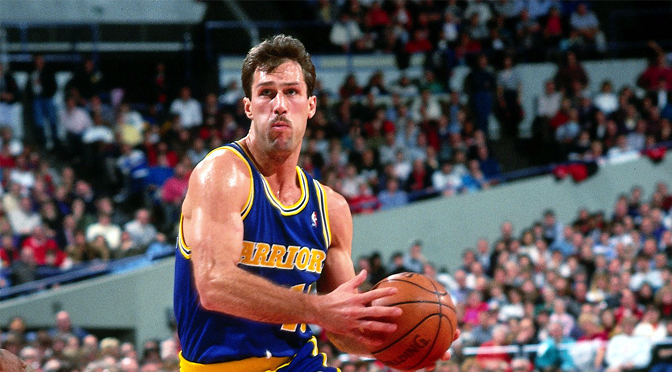
On November 3, 1989, Marciulionis made his NBA debut. And he did so in style despite his team’s loss to Phoenix by 106-136. The starting five in Golden State was Chris Mullin (24 points), Mitch Richmond (8), Tim Hardaway (0), Rod Higgins (15) and Uwe Blab (2) from Germany, while off the bench they had Marciulionis (19 points in 24 minutes), Terry Teagle and Manute Bol. On the other side we could find Kevin Johnson (18), Armon Gilliam (22), Tom Chambers (24), Jeff Hornacek (8), Tim Perry (8), Dan Majerle (27) and Eddie Johnson (22).
That night was the start of the NBA career of one of the best Europeans to ever play in the league. During seven seasons, interrupted by several serious injuries, Marciulionis played with the Warriors, Seattle Supersonics and Sacramento Kings for a total of 363 games. He scored 4,631 points with an average of 12.8. His career high were the 35 points against the New Jersey Nets in 1992.
At 1.96 meters, he was a shooting guard but he could play point easily thanks to his technique. His physical power also allowed him to grab a lot of rebounds. In the NBA, he pulled 9 rebounds several times while his assists record was 10. If I had to choose one element of his game to highlight, it would be his precise shooting. His fighting character was another thing that helped him become a great player.
After his first year in the NBA, in the Zagreb EuroBasket of 1989, Marciulionis (the best scorer of the team with an average of 18 points), Sabonis, Chomicius and Kurtinaitis played for the USSR for the last time to win the bronze medal. Their dream of playing with the Lithuanian national team happened three years later, at the 1992 Olympics in Barcelona. After playing at the qualifying round in Zaragoza, the Lithuanians won the bronze medal for their country, which had been European champion in 1937 and 1939 before losing its independence. Marciulionis as a shooting guard and Sabonis as a center, two kids born in the same year in Kaunas, took their country to the medal. Marciulionis averaged 34.4 points and Sabonis 23.9.
In a surprise, however, Lithuania failed to qualify for the 1993 EuroBasket in Germany. Without Sabonis, who was injured, and with Marciulionis not at 100 percent, the team couldn’t get through the Wroclaw preliminary phase. Last year, during EuroBasket in Lithuania, I interviewed Marciulionis in his Vilnius hotel “Sarunas” – next to his basketball school – and he told me that Wroclaw was the worst moment of his career. He shouldn’t have had to travel in the first place because he was injured, but once he was there he was convinced to “help in any way he could”, but he could not contribute a thing.
The great final in 1995
If someone like me, who has been following basketball for more than 50 years watching an average of three or four games per week, was asked what my favorite game was I would have a hard time finding an answer. I won’t even bother trying. But I am sure that among the best five I ever saw is the 1995 EuroBasket final in Athens between Yugoslavia and Lithuania. Yugoslavia won by 96-90 in an offensive festival on a great show put on by stars on both sides.
It was the game of a lifetime for Sasha Djordjevic, who finished with 41 points behind 9-for-12 three-pointers. But on the other side there was Marciulionis with 32 points with 8 of 9 two-pointers and 3 of 5 threes. That was the game in which Predrag Danilovic dunked over Sabonis (!). The game in which Sabas scored 20 points and pulled 8 rebounds, one less than Vlade Divac. The game in which a young Dejan Bodiroga confirmed his great talent with 12 points, 4 rebounds and 3 assists, just the same as Arturas Karnisovas, with 19 points, on the other side. Yes, it was a great final with also the spice added by the controversial refereeing decisions.
The following year, at the Atlanta Olympics, Yugoslavia won in the semis by 66-58, but Lithuania found some comfort with a new bronze medal after beating the Australia team of Andrew Gaze (25 points) by 80-74 behind 30 points by Sabonis, 21 by Karnisovas and 16 by Marciulionis.
The following year, after a season in Denver, he retired. In 1999, already as a director and businessman, he was a pioneer in organizing a regional league, the NEBL (Northern European Basketball League). Today, he moves between San Francisco, where his elder daughter from his first marriage lives, and Vilnius, where he has two young kids, a great hotel and the basketball school, which impresses everyone with the great quantity of registered kids infected with this national illness in Lithuania called basketball.
Sarunas Marciulionis, the Lithuanian machine.
(November, 2012)
