“31 Masterminds of European Basketball” was released in 2019 to profile the greatest coaching minds the game has seen on the European continent. The limited-edition book, written by EuroLeague historian Vladimir Stankovic—who began covering many of those greats in 1969—and published by Euroleague Basketball, pays tribute to the stars on the sidelines who have led teams to countless titles. Stankovic tells the stories and digs into the strategies of each of the 31 profiled coaches and in doing so paints the path to trace greatness among European basketball coaches to the 1950s. However, it’s not just about the history of European coaches; five of them will coach in the EuroLeague this season. Enjoy!
***
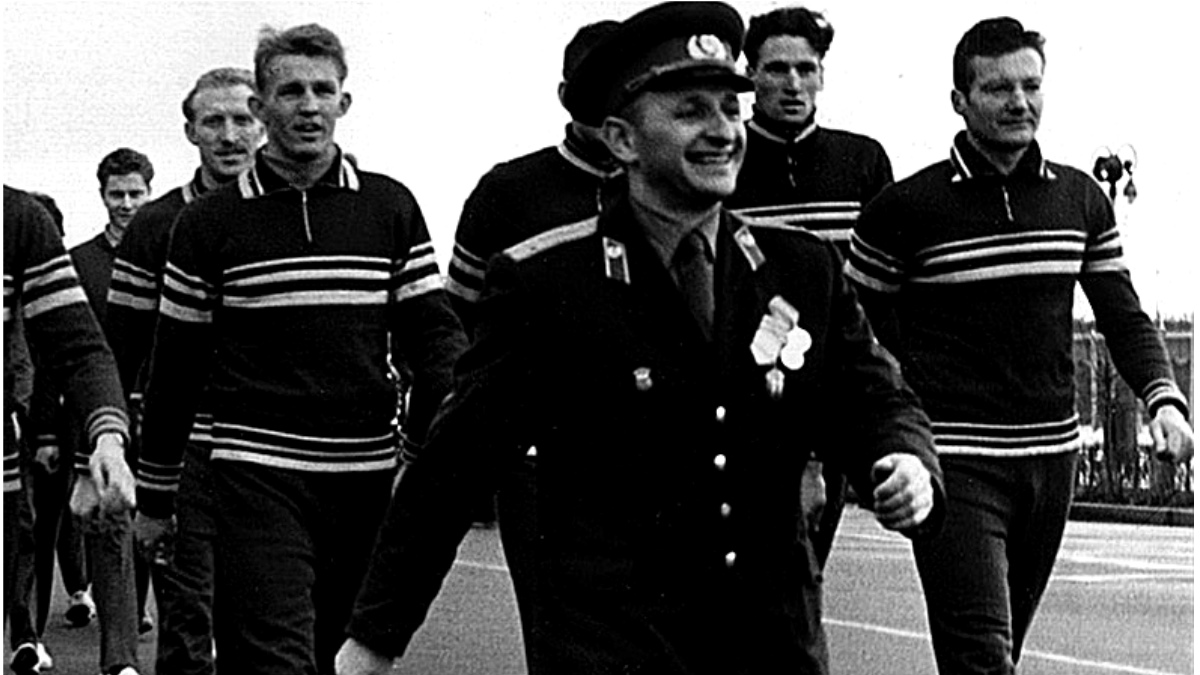
Alexander Gomelskiy – The basketball general
Entire books have been written about Alexander Gomelskiy. The most complete of those was a 500-pager entitled “Papa”, written by his son Vladimir, a well-known Russian basketball commentator. And I am afraid that even though it will be quite long, this chapter won’t fit many of the most defining characteristics of this great coach. Let’s try.
Alexander Yakovlevich Gomelskiy was born on January 18, 1928 in Kronstad (Russia) to a family of Jewish descent, something that would not always help him during his future career.
At a very young age, in 1944, he joined the Red Army that freed first his country and, after that, half of Europe. In Saint Petersburg – then called Leningrad – he started playing basketball. Due to his short stature, his natural spot was point guard. His knowledge about basketball and sports in general grew wider when he started studying physical education at a civilian school, but he wrapped up his studies at a military academy, where he graduated as a young officer.
Soon after that, still as a player on the military team, Gomelskiy started his career as a coach. His first job was with the Spartak women’s team. In the first practice, he got to meet Nina Zuravleva, also a coach, and the woman who in the not-so-distant future would become his mother-in-law. In the same practice, he also met a young player, Olga Pavlova Zuravleva, the daughter of Nina, and his future wife.
After one of the games, a player named Eudokina Belov told him: “Sasha, in the second timeout, you only yelled at us. Not one piece of advice. How do you expect us to correct mistakes without instructions?” That was a lesson he remembered for the rest of his career: communicate and talk to the players.
His first successes came in 1951, when Gomelskiy was double champ in Leningrad, as a player on the military team and as the coach of Spartak. As a player he was a candidate for the Soviet team that went to the Olympic Games in Helsinki in 1952, but didn’t make the final cut. He was told he was too short.
That same year, already married and in the military, he was assigned to Rumbule, some 65 kilometers from Riga, in Latvia. From there, he soon got to Riga and started coaching ASK, a team that also belonged to the army. The abbreviation stands for Sports Club Army (or Army Sport Klub Riga), but normally it is just known as ASK Riga. There, in 1953, his true career as a coach started, and his son Vladimir was born.
Krumins, the first big man
From the very first moment, Gomelskiy knew that to have a great team he needed some great players. Taking a look at all his teams, he always had some stars who could carry the team and put his ideas into practice. The building of the great ASK Riga started with Maigonis Valdmanis, a player with the character of a leader. The second key man was Gunar Silnish, and the third was Ulis Heht.
However, the key piece of the puzzle arrived as if fallen from the sky. One day, a giant appeared at practice. His name was Janis Krumins. His stood 2.18 meters tall and weighed in at 145 kilograms. Right away, Gomelskiy uttered his famous words: “We found our big man.”
The young giant was seeking a sport in which he could exploit his natural strength. He tried it with athletics (javelin) and wrestling, without much success. He was slow, clumsy and didn’t have a lot of instant talent for basketball, but Gomelskiy knew that he had a diamond in the rough. All he needed was the patience to polish it well. Both men spent countless hours in the gym carrying out individual work, and the experience with Krumins would greatly help Gomelskiy later on with another giant and important player, Vladimir Tkachenko.
Krumins was willing to work hard and he learned fast, so in a short time he became a player who made a difference. He was European basketball’s first giant and was soon on the USSR team for the 1956 Olympics in Melbourne, where in the final he met the future NBA star Bill Russell. Gomelskiy also travelled to Melbourne with the national expedition, as a coach, on a boat that sailed from Odessa. It was his first big experience abroad.
ASK Riga won the USSR championship in 1957 and when FIBA created the EuroLeague, the Latvian team was the representative of the country. ASK first eliminated Wissenschaft of East Germany and then did the same with Legia Warsaw in the quarterfinals. In the semis, the opponent was Real Madrid, but there was no duel. The Spanish team, under the orders of General Franco, rejected playing “against communists”, so ASK Riga advanced to the final without even playing. The other finalist would be Akademik Sofia, and the first title game of the new competition was played on July 6, 1958 in the football stadium of Daugava, in front of 17,000 fans. ASK won 84-71.
Vladimir Gomelskiy recounts in his book that the ASK players received economic rewards for the title, and most of them could afford a Soviet-made Pobeda car. ASK would go on to be the competition champ in the following two editions as well, a feat that would only be repeated by the great Jugoplastika Split teams from 1989 to 1991. ASK also won three USSR leagues.
A series of friendly games between the USSR and the United States in 1958, both men and women, opened Gomelskiy’s eyes. Even though the Americans played with college players, he saw a different basketball, guided by great individual technique and ball-handling that nobody in the USSR was able to replicate. From then on, Gomelskiy was captivated by the style of work in the States, something that became a full obsession after the 1960 Olympics in Rome.
Gomelskiy went to the FIBA Basketball World Cup in Chile and the FIBA EuroBasket in Istanbul, both in 1959, as part of the coaching staff, but he did not travel to the Rome Olympics in the same role. His differences with head coach Stepan Spandaryan were growing bigger every day and his criticism towards the team’s “conservative style” also became stronger. So Gomelskiy only went to Rome as a spectator, and came back impressed with the USA team, which featured all-time greats like Oscar Robertson, Jerry West and Jerry Lucas.
Even though he appears in the record books as the head coach for the USSR in the 1961 EuroBasket in Belgrade, that is not true. In the scoresheets for the game, the name of Spandaryan still appears. Also, his son Vladimir mentions in his book it was not until 1963 that his father was named head coach of the Soviet team. That was also the year when the family finally moved to Moscow for good, and when Gomelskiy took the reins at CSKA, also an army team.
In May 1963, the USSR finished third in the World Cup in Rio de Janeiro. The team lost to Brazil and Yugoslavia, whose bench was helmed by Aleksandar Nikolic. A great rivalry between Gomelskiy and Nikolic, with their national teams as well as their clubs, Ignis Varese and CSKA, would go on for the following 15 years, until the title game at the 1978 World Cup in Manila.
In the 1963 EuroBasket in Poland, the USSR won the gold medal and would do the same in 1965, 1967, 1969, 1971, 1979 and 1981. It also won two silvers, in 1977 and 1987, and a bronze in 1983. Gomelskiy also won the World Cup in 1967 and 1982, was finalist in 1978, and took third in 1963 and 1970.
After the 1964 Olympic silver in Tokyo, bronze in Mexico 1968 and Moscow 1980, his team finally won the gold in Seoul 1988, beating the USA team of David Robinson, Dan Majerle, Stacey Augmon and Danny Manning in the semifinals, and then overcoming the Yugoslavia of Toni Kukoc, Drazen Petrovic, Vlade Divac and others in the title game.
That was the last great USSR team, with Arvydas Sabonis, Alexander Volkov, Sergey Tarakanov, Sarunas Marculionis, Rimas Kurtinaitis and many more. Gomelskiy totaled 18 medals with the USSR (9 EuroBaskets, 5 World Cups, 4 Olympics). Curiously enough, his brother Evgeniy won the gold medal with the women’s team of the Russian Federation at the 1992 Barcelona Olympics, and that’s still the only case of coaches who are brothers and Olympic champions.
With CSKA, Gomelskiy coached several finals of the old EuroLeague, and in many places it says that he was the European champ in Antwerp, Belgium in 1971 … but that is only half true.
It is the case that Gomelskiy was head coach for CSKA that season, but he was not on the bench during the title game. For reasons that were never cleared up, the Soviet authorities held his passport, so Sergei Belov was player-coach for that game.
Neither was Gomelskiy at the 1972 Olympics in Munich. The rumor was that the KGB suspected that, since he was of Jewish descent, he may emigrate to Israel. It was a theory with a weak foundation because Gomelskiy had dozens of chances to emigrate prior to that and had not done so. But he was prevented from traveling and his great local rival, Vladimir Kondrashin, won the gold medal in a famous final against the United States, with the last three seconds repeated under orders from William Jones, the FIBA secretary general, which Alexander Belov turned into a win after having lost the first time.
Silver Fox
Gomelskiy was a very clever coach and was in total accord with his nickname, “Silver Fox”, because of his white hair and his smarts. He never hesitated to use any tools at his disposal to win games: if he had to put pressure on referees, he did it; if he had to provoke the best player of the opponent, he was willing to do it; if he had to steal the best player of the biggest rival, he went ahead.
His relationship with his star players went through different phases, from mutual adoration to the other extreme of almost hatred. For instance, in an interview he gave me, Sergei Belov accused Gomelskiy of many dubious things.
It is true he had a character that was not easy to understand, but nobody can doubt his coaching qualities. And personally, I only had good experiences with him. I met him at a game in 1977 in Moscow, and from that point until his death we had a very good relationship, especially during the initial Euroleague Basketball years, when I was Communications Director and he was the president at CSKA. He called me Volojda, a typical Russian variation of my name, Vladimir.
Some approximate calculations say that Gomelskiy coached some 2,600 games and won about 70% of them. At the end of his career he worked in Tenerife, Spain and Limoges, France. He was named best Russian coach of the 20th century. As an officer, he held the rank of colonel, but as a coach, he was no doubt the general.
After retiring from coaching, he was president of the USSR Basketball Federation and then president at CSKA. Sometimes he commentated games on TV with his son Vladimir. In 2007, he made the Naismith Memorial Basketball Hall of Fame in Springfield, Massachusetts.
When CSKA won the EuroLeague title in Prague in 2006 after 35 years without the crown, they dedicated it to him, because Gomelskiy had died on August 16, 2005 and could not witness the club’s return to the European throne.
His legacy continues: CSKA, with which he won 16 league titles, organizes a summer tournament in his name, while Euroleague Basketball has named its annual Coach of the Year award the Alexander Gomelskiy Trophy.
I hope it’s clear why.
Photo: Euroleague
