
“31 Masterminds of European Basketball” was released in 2019 to profile the greatest coaching minds the game has seen on the European continent. The limited-edition book, written by EuroLeague historian Vladimir Stankovic—who began covering many of those greats in 1969—and published by Euroleague Basketball, pays tribute to the stars on the sidelines who have led teams to countless titles. Stankovic tells the stories and digs into the strategies of each of the 31 profiled coaches and in doing so paints the path to trace greatness among European basketball coaches to the 1950s. However, it’s not just about the history of European coaches; five of them will coach in the EuroLeague this season. Enjoy!
***
Xavi Pascual, Basketball engineer
Of course, the title is figurative, but it sums up two important things in the life of Xavi Pascual: his professional formation and the passion that later became his profession. Between 2001 and 2005 Pascual, an industrial engineer, worked in the city hall of Viladecans, a town in the Barcelona area. However, his soul gravitated towards basketball.
To find his basketball origins, we have to go back to 1990, when Pascual coached kids at the humble CB Gava club. His way to the top was slow, but always in the right direction. He went step by step, with patience and the will to learn. When he signed for CB Cornella in 1994 to coach the under-20 and B teams, it was a huge step forward. Between 1995 and 1997 he was an assistant for Agusti Cuesta in that club.
His next stages were in the lower national categories with CB Santfeliuenc and CB Olesa, a team that Pascual managed to promote to the Spanish fourth division. He then won that league with Aracena, moved up to the third division and, the following season, to the second. The qualities of the young coach did not go unnoticed, and in 2004 he got a surprise call from FC Barcelona.
He was signed as a coach for the team in the fourth division and also as a coordinator for youth teams. By the 2005-06 season, Pascual had become an assistant coach for the FC Barcelona first team under Dusko Ivanovic. That’s when he decided to go full-time with basketball and went from an industrial engineer to a basketball engineer. He was up for the challenge, even if he knew that it would be no bed of roses.
The key moment in his career took place in February of 2008. Ivanovic was released after saying that he could do no better with the team he had, so the club used the temporary solution of promoting assistant Pascual to the helm. However, that temporary measure lasted a few seasons and was successful, to boot.
Pascual started with a contract until the end of that season, in which Barcelona finished second in the Spanish League regular season. In the playoffs, Barcelona swept Valencia 2-0 in the quarterfinals and then won 2-1 against Unicaja in semis. For the finals, the opponent was Baskonia, which had earned the home-court advantage. Barca and Pascual started the series with a surprising road win in Vitoria. Baskonia was leading 80-79, but with 2 seconds on the clock, Gianluca Basile netted a three-pointer from 8 meters – his only shot that day – but it gave the edge to Barcelona. It was a close game that went to the wire and featured a surprising coach on the opposing bench: Dusko Ivanovic.
“The game started badly for us,” Pascual said that day. “Baskonia had 22 shots in the first quarter, and we had 10 – and that was a burden. In the second quarter, we managed to come back on all fronts, and we had some small advantages that were decisive in the end. In the end, a single shot decided the game and we were lucky.”
Baskonia tied the series two days later, winning 75-67, but the next two games were to be played in Barcelona, and the hosts managed to win them both, 85-67 and 90-77, to become the Spanish champs. A coach with three months’ worth of experience at the head of the bench in the Spanish League was now a champion!
“Doubt was a normal thing when I took the reins of the team because I was a young coach and it’s normal that people have these doubts,” Pascual said. “I think the team played at a good level all season; we were consistent. I am happy to have won dishing 20 assists because it shows we are a team in which everybody helps each other. We are united.”
Thos 20 assists that he mentioned define Pascual’s philosophy as a coach.
“Coaches have to adapt to the players that they have in order for things to work,” he said in an interview. “If you have marathon runners you cannot sprint. If you have sprinters, you cannot make them run a marathon. The important thing is to win.”
Some say that Pascual is a defensive coach first, but his teams score many points on the fastbreak.
“You play 24 seconds on defense and 24 on offense. Another thing is whether you try to run or not when you steal the ball,” Pascual stated. “My teams try to defend, run and play in a dynamic way.”
The stellar moment of his career was in 2009-10. Barcelona ended the EuroLeague regular season as Group A leader with a 10-0 record, averaging 83.3 points, against Montepaschi Siena, Zalgiris Kaunas, Cibona Zagreb, ASVEL Villeurbanne and Fenerbahce Istanbul. In the Top 16, Barca just lost a single game against Partizan, 66-67, defeating Panathinaikos and Maroussi twice.
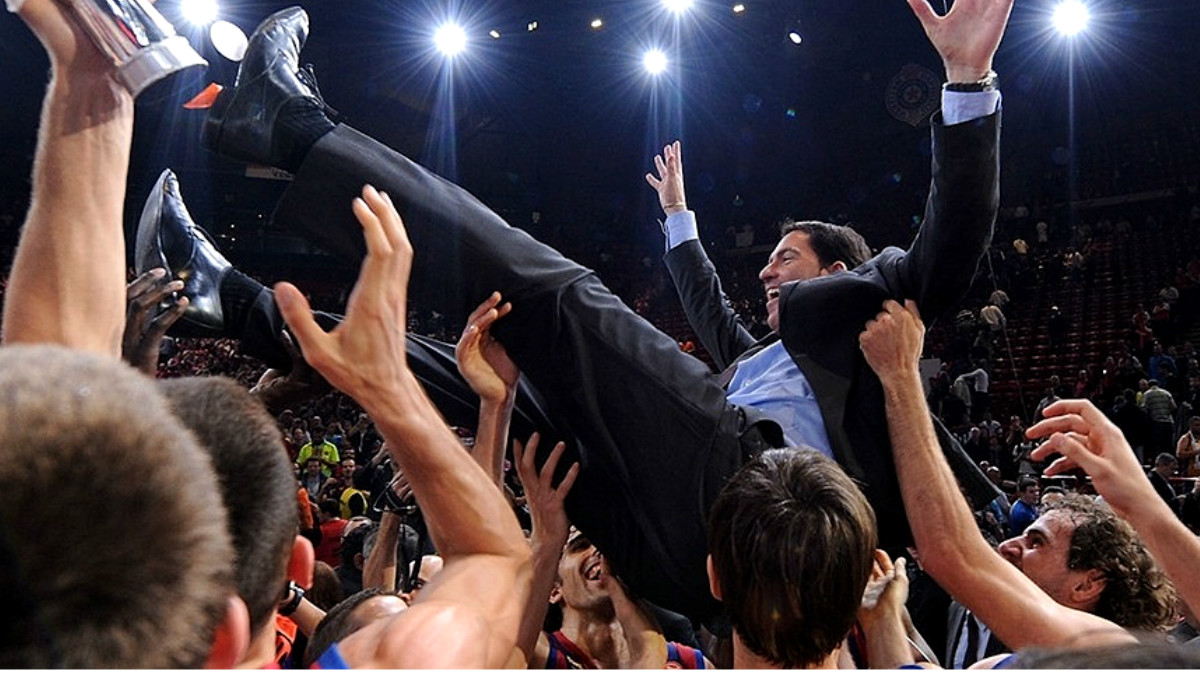
In the playoffs, Barcelona managed to get rid of archrival Real Madrid, coached by Ettore Messina, with a 3-1 decision that sent the team to the Final Four in Paris. There, at Bercy Arena, Barca defeated CSKA Moscow in the semifinals, 64-54, thanks to great defense. Olympiacos waited in the title game, which Barcelona dominated from start to finish winning all quarters for an 86-68 final score. The legendary Juan Carlos Navarro was named Final Four MVP with 21 points on 4-for-9 three-point shooting, and Barcelona lifted its second EuroLeague title.
“We played 22 games in the Euroleague this season, and we won 20,” Pascual said. “So it’s been a wonderful season for us, and this was a great way to close it out. Tonight, we moved the ball very well, we attacked well, played defense, got free throws. It’s difficult to do in the final, but we played our game, and we stuck with the way we play. I am delighted and I am happy for our players, who worked hard all year and got rewarded with this victory.
“Coaches always live for their last game. This one was marvelous. It’s a wonderful, important moment. I know the life we have as coaches. In the future, we can lose and anything can happen in the crazy world of coaching. But you should never doubt. You have to walk forward clearly and look things straight in the face.”
Xavi Pascual knows how to treat stars. He shares the idea that basketball is a collective game and that results depend on the work of the whole team, but he knows that the best ones need to be protagonists. In Barcelona, he worked with several stars, especially Navarro. Later, Pascual worked at Panathinaikos Athens and he had Nick Calathes.
Because of his age – he was born on September 9, 1972 – Pascual is still a young man, but with almost 300 games in the EuroLeague (290 between Barcelona and Panathinaikos) and many titles conquered, he is an expert coach. His resume includes, aside from the 2010 EuroLeague crown, four Spanish Leagues and three Spanish Cup trophies, two Greek Leagues, a Greek Cup, four Spanish SuperCups and seven Catalan Leagues. In Spain, he was chosen coach of the year in 2009, 2010 and 2011. His worst year, with “only” a 67.6% winning percentage, was in 2012-13. His best one was a 26-0 finish in the Greek League regular season with Panathinaikos in 2017-18.
Pascual is a coach with character, but also polite. He was hardly ever called for technical fouls. His statements after games were always at academy level, with full respect for the opponent. In December of 2018, Pascual was waived by Panathinaikos, but he accepted his new situation in a very natural manner.
“When you are a coach, you know there are some decisions that you cannot control,” he said after leaving Athens. “You just know that you have to do your best and not think about it too much. I tried to give my best and things were great. At the start of the season, we were fighting to be in the EuroLeague Playoffs.”
There’s no doubt that being the kind of coach he is, Xavi Pascual will not be unemployed for long. Basketball needs him.
Photo: Euroleague
